A Guide from Dr. Starsiak · Daily Routine
Dinacharya —
the daily rhythm
Ayurveda's daily routine, read through a physician's eyes. The practices matter — but the real medicine is that you repeat them. Here's what each one is, what the evidence actually says, and how to start without overhauling your life.
The idea
The active ingredient
is rhythm
Dinacharya — from dina (day) and acharya (conduct) — is the Ayurvedic daily routine. It's a sequence of small practices, from how you wake to how you wind down, designed to keep the body aligned with the natural cycle of the day. Some of them are millennia old, and a surprising number line up neatly with modern circadian biology.
Here's the part that matters most, and it's easy to miss: the individual practices are useful, but the routine itself is the intervention. Your body runs on clocks — hormones, digestion, temperature, alertness all follow a daily rhythm — and those clocks are set by consistent cues: light, meals, movement, and sleep arriving at roughly the same time each day. A modest routine you actually repeat does more than an elaborate one you abandon by Thursday.
So read this the way I'd want a patient to: not as a checklist of ten things you're now failing to do, but as a menu. Pick two or three, make them automatic, then add. I'll be honest throughout about which practices have real trial evidence, which are traditional and mechanistically plausible, and which are simply pleasant — because you deserve to know where you're standing on solid ground and where you're standing on tradition.
- Good modern evidence — randomized trials or strong physiology support the practice.
- Modest evidence — real human studies, but small, mixed, or best seen as an adjunct.
- Traditional & plausible — long-used and mechanistically reasonable, but thin on modern trials.
- Comfort & ritual — gentle, low-risk, and valuable mostly for how it makes you feel and the consistency it anchors.
The morning
How you start sets
the whole day
Ayurveda puts most of the routine in the morning for a reason — it's when you set the clocks. You don't need all of this. If you took only the first two, you'd have the highest-value pieces.
- Wake at a consistent time — and get light (good modern evidence). Ayurveda says rise near dawn; modern circadian science says the same thing in different words. A consistent wake time and bright light in the first hour are the strongest anchors your body clock has — they improve sleep, mood, alertness, and metabolic health. Ten to thirty minutes of outdoor morning light is ideal; on dark winter mornings a 10,000-lux light therapy lamp is a reasonable stand-in. This one practice does more than any product on the page.
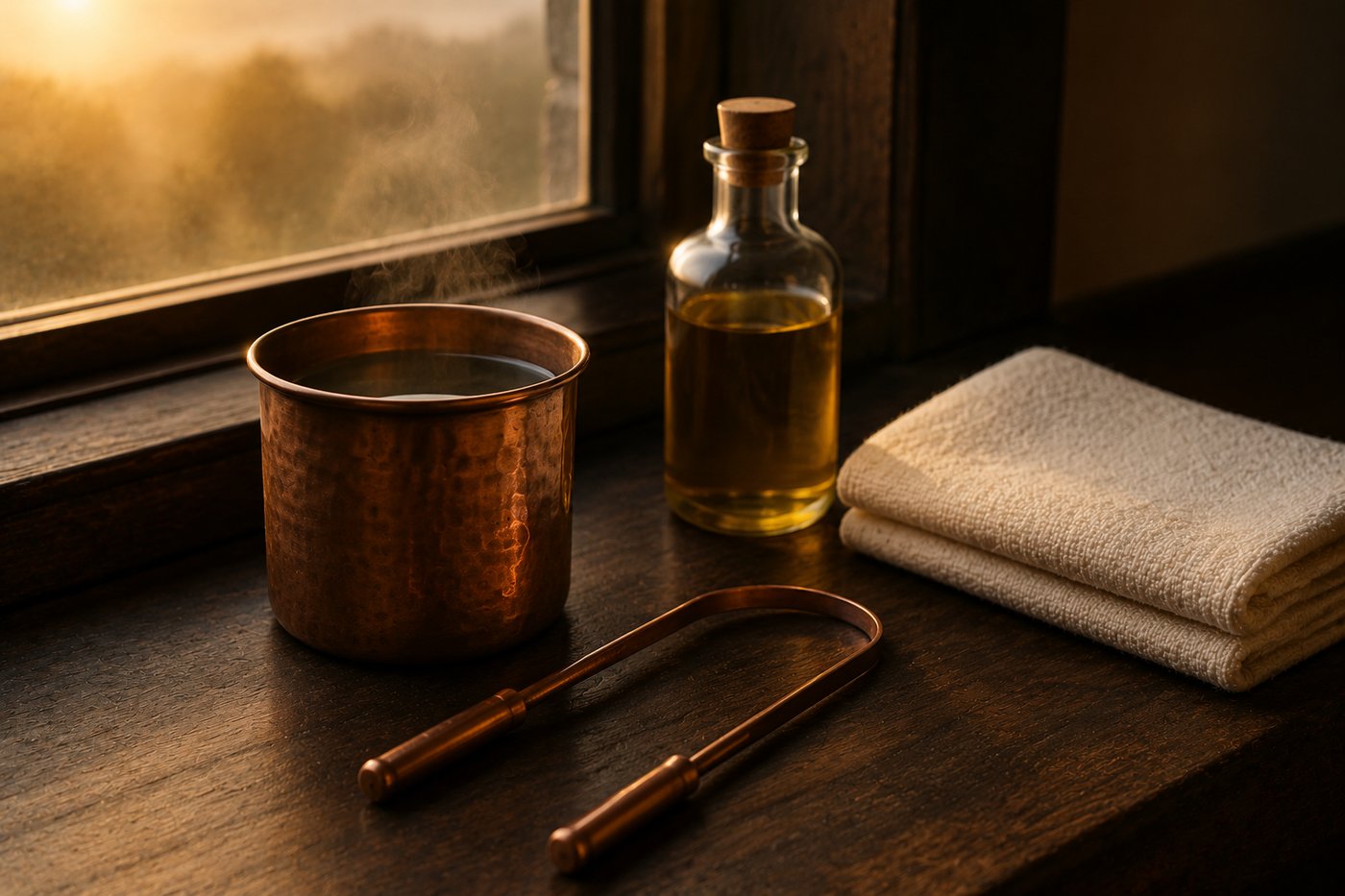
- Warm water on waking (traditional & plausible). A glass of warm water first thing is traditional for stimulating digestion and elimination. The mechanism is simple and reasonable — hydration after a night's fast, a warm stimulus to a sleepy gut. Some add lemon; fine, though rinse afterward so the acid doesn't sit on your enamel. Traditionally this is done from a copper vessel — copper is genuinely antimicrobial, though don't overdo it, since excessive copper intake isn't harmless.
- Regular elimination (good modern evidence for the fundamentals). A morning bowel movement is a sign the routine is working. The levers are unglamorous and well-proven — fiber, water, movement, and rhythm. When things are sluggish, triphala is the classic gentle, non-habit-forming Ayurvedic option, and it's covered in more depth on the gut health guide. → Amazon · dispensary
- Tongue scraping (modest evidence). Scrape the tongue front-to-back a few times before brushing. A Cochrane review found tongue scrapers produce a real, if short-lived, reduction in the volatile sulfur compounds behind morning breath — so this isn't just ritual, it measurably works for what it claims. A copper or stainless tongue scraper costs a few dollars and lasts years. → dispensary
- Oil pulling (modest evidence). Swish a tablespoon of oil for five to fifteen minutes, then spit it into the trash (not the sink — it can clog drains). Randomized trials and a systematic review show it can reduce plaque, gum inflammation, and cavity-causing bacteria, in some studies comparably to certain mouthwashes. The honest caveat: the trials are small and lower quality, and it's an add-on, not a replacement for brushing and flossing. Coconut oil has the best-tasting evidence; sesame is the traditional choice. → coconut · sesame · dispensary
- Nasya — nasal oil (traditional & plausible). A drop or two of medicated oil (classically anu taila) in each nostril is traditionally used to lubricate the nasal passages and support clear breathing and mental clarity. Modern trial evidence is thin, so I'll call it what it is — traditional and reasonable, not proven — but many people find it soothing, especially in dry indoor-heat months. Skip it if you have active sinus infection. → Amazon · dispensary
- Neti — saline nasal irrigation (good modern evidence — with one hard safety rule). This is the practice on the page with the strongest modern support: saline rinsing measurably improves symptoms in chronic sinusitis and allergic rhinitis and helps with colds. The non-negotiable rule: use distilled, sterile, or previously boiled-and-cooled water — never straight tap water. Tap water can rarely carry an amoeba (Naegleria fowleri) that is harmless to swallow but can cause a fatal brain infection when it enters through the nose. Add the premeasured salt packet, rinse the pot, and let it air-dry between uses. Done right, it's safe, cheap, and genuinely effective. → neti pot & salt
- Abhyanga — warm-oil self-massage (traditional & plausible). A few minutes massaging warm oil into the skin before a shower is one of the most beloved parts of the routine. The trial evidence is modest and mostly about relaxation and stress, which is honestly the point — it's a daily nervous-system down-regulation you give yourself. Warm sesame oil is the classic all-purpose choice; a lighter oil like coconut suits warm weather. A quicker, stimulating variant is dry brushing (garshana) before the oil. → massage oil · dry brush · dispensary
- Movement (good modern evidence). Ayurveda calls it vyayama and recommends moving to a light sweat in the morning; modern medicine simply calls exercise the closest thing we have to a universal drug. Morning movement also reinforces the circadian signal you started with light. If you're not sure where to begin, start with the basics done well — getting started with strength training →
- Sitting quietly — breath or meditation (good modern evidence). A few minutes of slow breathing or meditation before the day's noise starts has solid evidence for stress, blood pressure, and focus. It doesn't need to be elaborate; it needs to be daily.
The midday
Eat when your digestion
is strongest
Ayurveda holds that digestive fire — agni — peaks around midday, so the largest meal should be lunch. This is one of those places where an ancient instinct and modern data agree: eating earlier in the day, with a bigger midday meal and a lighter evening one, aligns food intake with your circadian clock, and studies of early time-restricted eating show better glucose control and insulin sensitivity when calories land earlier rather than late at night.
You don't have to become rigid about it. The practical version: make lunch your real meal, get outside for a few minutes of midday light, and let dinner be the smaller, earlier one. If blood sugar or weight is part of your picture, this timing is quietly powerful — more on the mechanism in the blood sugar guide.
The evening
Wind the day down,
don't slam it shut
The evening routine (ratricharya) is really sleep preparation, and it's where most people's rhythm falls apart. The principles are simple and well-supported:
- An earlier, lighter dinner (good modern evidence) — finish eating a few hours before bed. Late, heavy meals worsen sleep, reflux, and next-morning glucose. This also gives you a natural overnight fast, which the gut uses to clean house — see the gut health guide.
- Dim the lights and cut the blue light (good modern evidence) — bright and blue-heavy light in the evening suppresses melatonin and pushes your clock later. Dim the house, use warm lighting, and put screens down an hour before bed — or use blue-blocking glasses in the evening if screens are unavoidable.
- A consistent wind-down (comfort & ritual, and it works) — a warm shower, a few minutes of the warm-oil massage on the feet, slow breathing, a book instead of a feed. The specific ritual matters less than its consistency; you're teaching your body that sleep is coming.
- Regular, early-ish bed (good modern evidence) — a consistent bedtime is as important as a consistent wake time. Which plants support sleep without wrecking its quality — and why alcohol, THC, and many prescription sleep aids quietly do the opposite — is its own subject, covered in the sleep & insomnia guide.
Where to begin
Start small,
or you'll quit
The failure mode of dinacharya is enthusiasm — trying all ten practices on Monday and none by Friday. Build it like any durable habit: a few anchors first, layered slowly.
Week one: a consistent wake time with morning light, and an earlier, lighter dinner. Nothing to buy. These two set the clock.
Week two or three: add the mouth-care pair — tongue scraping and oil pulling — and a few minutes of morning movement or breathing.
Once those are automatic: layer in whatever fits — abhyanga on the days you have ten minutes, neti in allergy season, nasya in the dry months, the evening screen cut-off. Keep what earns its place in your life and quietly drop what doesn't. A routine is a living thing, not a scorecard.
The tongue scraper, oils for pulling and massage, nasya oil, neti pot, and triphala I use are in my online dispensary at patient pricing, and the everyday items — a light lamp, blue-blockers, a copper bottle — are linked to Amazon above where they come up. Or buy any of it anywhere; these are simple tools, and the routine is what matters, not the brand.
From the Channel
Watch: how to begin a meditation practice

Common Questions
Dinacharya — FAQs
What is dinacharya?
The Ayurvedic daily routine — a sequence of simple practices from waking with the light to a wind-down before bed, meant to align the body with the rhythm of the day. The individual practices matter, but the real active ingredient is consistency: a modest routine you repeat beats an elaborate one you abandon.
Do I have to do all of it?
No — trying to is the most common way people quit. Start with two or three practices (usually a consistent wake time with morning light, tongue scraping, and an earlier, lighter dinner) and add one at a time once those are automatic.
Is oil pulling actually proven?
It has modest, real evidence — trials and a systematic review show reductions in plaque, gum inflammation, and cavity-causing bacteria, sometimes comparable to mouthwash. But the studies are small, and it's an add-on, not a replacement for brushing and flossing.
Is a neti pot safe?
Yes, with the right water. Saline irrigation has good evidence for sinus and allergy symptoms. The non-negotiable rule: use distilled, sterile, or previously boiled-and-cooled water, never untreated tap — tap water can rarely carry an amoeba that causes a fatal infection through the nose. Rinse and air-dry the pot between uses.
What's the single most important practice?
A consistent wake time with bright light in the first hour, plus an earlier, lighter dinner. Those anchor your circadian clock, which has strong evidence for sleep, metabolism, and mood. If you keep only two things, keep those.
What oil should I use?
For oil pulling, coconut oil has the best trial support and taste; sesame is traditional. For abhyanga self-massage, warm organic sesame oil is the classic all-purpose choice, with coconut a lighter warm-weather option. Choose organic, food-grade oil and warm it gently.
Dinacharya is most powerful when it's tailored — the right practices, oils, and emphasis depend on your constitution, your season of life, and what your body is actually doing. If you want a routine built for you rather than a generic list, that's exactly what a visit is for. It also pairs naturally with the Fall Seasonal Reset and a deeper functional-medicine workup.
This guide is general education, not medical advice, and it does not create a physician-patient relationship. Dinacharya practices are generally low-risk, but a few cautions are specific and real: use only distilled, sterile, or previously boiled-and-cooled water for nasal irrigation; don't ingest excessive copper; introduce herbal bowel support gradually; and check with your physician or pharmacist before adding herbs if you are pregnant or breastfeeding, take prescription medications, or have a chronic medical condition. Nasal and oil practices should be paused during acute infection. These statements have not been evaluated by the FDA and are not intended to diagnose, treat, cure, or prevent any disease. Disclosure: As an Amazon Associate, Starsiak Osteopathic Clinic earns from qualifying purchases through the Amazon links on this page, and Dr. Starsiak earns from purchases through the Fullscript dispensary — at no extra cost to you. The price you pay is unchanged, and the advice is the same wherever you buy.