A Guide from Dr. Starsiak · Root-Cause
Improving your gut health
from the root
Not the 28-day "gut reset." Why your digestion is off in the first place — the food that actually rebuilds it, the tools that calm a cramping gut, and the warning signs that mean you need a scope, not a supplement.
Most digestive trouble is benign and responds well to the work below. But a handful of features mean you need to be evaluated before you treat yourself with anything on this page — that link goes straight to a visit request: blood in the stool or black, tarry stools; unintentional weight loss; iron-deficiency anemia; trouble or pain swallowing; persistent vomiting; symptoms that wake you at night; or a new change in bowel habit after about age 45–50 — especially with a family history of colon cancer, inflammatory bowel disease, or celiac. And several of the strongest tools for reflux, IBS, and inflammatory bowel disease are prescription-only — a visit puts them on the table.
IBS is a diagnosis made after the dangerous things are ruled out. Inflammatory bowel disease, celiac, microscopic colitis, and colon cancer can all masquerade as an irritable bowel. If any of those flags are present, the highest-value next step isn't a supplement — it's a proper workup.
A better question
Not which probiotic —
but why
"Gut health" is a vague target, and vagueness is why so many people spend a fortune on supplements and feel no different. Your gut isn't one problem. It's at least four, and they need different tools: the upper gut (reflux, heartburn, that heavy, too-full feeling after meals), the irritable bowel pattern (bloating, cramping, urgency, alternating constipation and diarrhea), motility (things moving too slowly or too fast), and the microbiome-and-lining layer underneath all of it — the trillions of microbes and the single-cell barrier that decide how much of your immune system stays calm.
So the useful question isn't "which probiotic should I take." It's why is digestion off in this particular person — a diet with almost no fiber diversity, a course of antibiotics that never recovered, chronic stress running straight down the gut-brain axis, a reflux problem being fed by late meals, a post-infectious gut that never reset, or simply eating six times a day so the gut never gets to clean house.
That distinction is the whole thing. Supplements can be genuinely useful, and several below have real human data. But they work best as targeted tools inside a broader plan — not as a replacement for the food and rhythm that actually build a gut.
Natural medicine is most valuable when it expands our options without weakening our standards. Some traditional gut remedies now have meaningful human evidence. Others are soothing and plausible but thinly studied. The honest approach uses each for what it is — and is candid about where a popular product is mostly marketing.
- Core evidence — meta-analyses or multiple randomized human trials, with a plausible clinically meaningful effect.
- Supportive evidence — human research is favorable, but smaller, narrower, or more mixed.
- Emerging evidence — real human signals, but not yet strong enough to lean on as a primary therapy.
- Traditional or mechanistic interest — soothing, biologically plausible, or long-used, but I won't dress it up as proven.
One honest note up front: the gut is the most heavily marketed corner of the supplement world, and the gap between the claims and the evidence is wide. Where a product is oversold, I'll say so — including when the guideline-level evidence points the other way. That's more useful to you than another confident sales pitch.
From the Channel
Watch: principles for improving digestion

The foundation
Food builds the gut.
Everything else is adjunct
Before any capsule, the thing nobody selling supplements wants to lead with: your microbiome is mostly built by what you eat, and it responds fast. Two levers do most of the work.
Fiber diversity — feed the microbes, don't just take one. The bacteria that keep your gut lining and immune system calm live on the fibers in plants. The specific target that has guideline support is soluble fiber: the American College of Gastroenterology recommends roughly 20–35 g of fiber a day, weighted toward soluble sources, for global IBS symptoms. The practical version isn't a number — it's range. Thirty different plants across a week does more than a big dose of one. Soluble fiber (oats, legumes, psyllium, flax, most fruit and vegetables) is the friendly kind; coarse insoluble bran can actually worsen an irritable bowel, which is why "just eat more fiber" sometimes backfires.
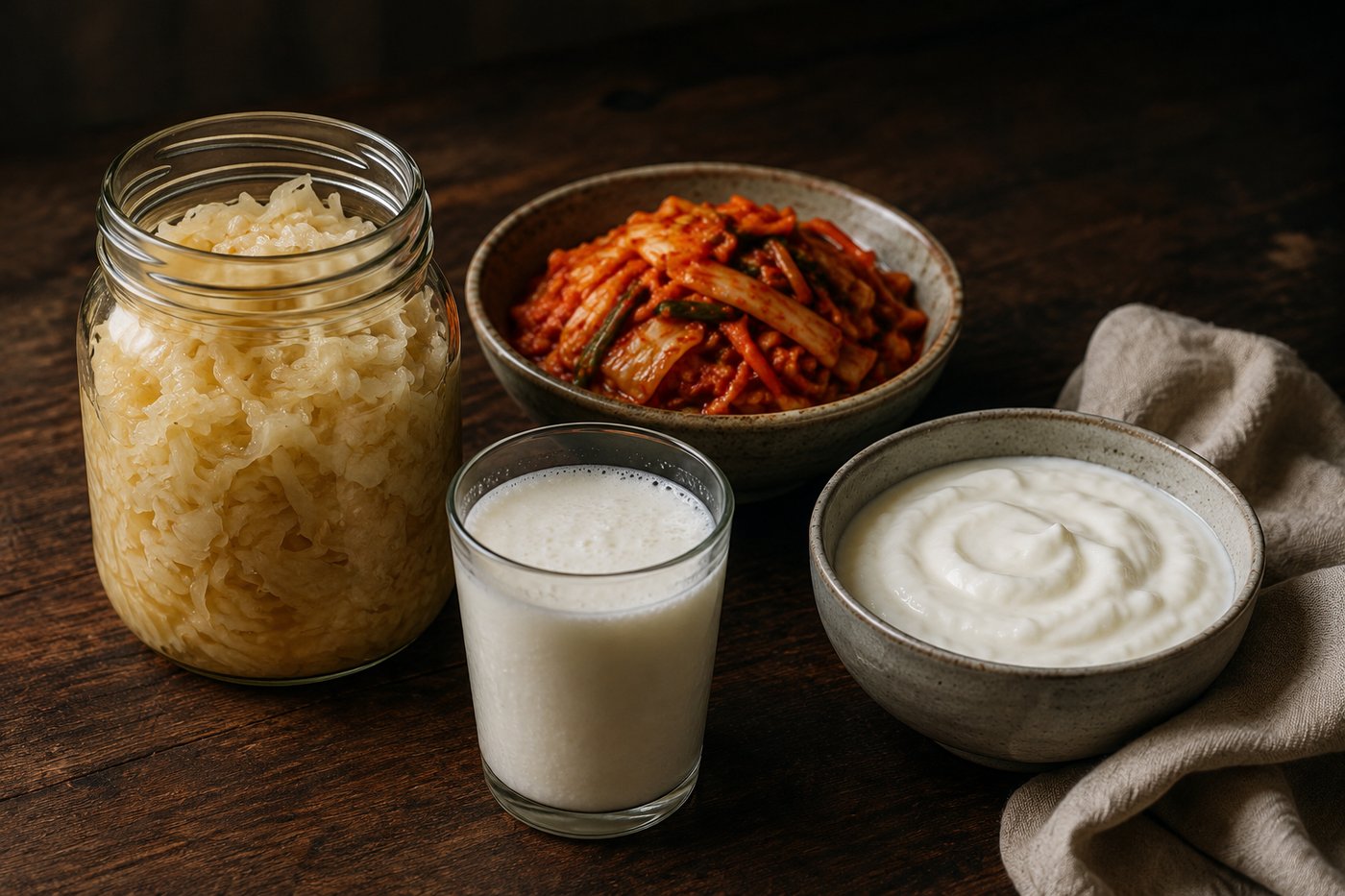
Fermented foods — the underrated win. A Stanford trial put this in sharp relief: over ten weeks, adults who worked up to about six daily servings of fermented foods — yogurt, kefir, kimchi, sauerkraut, brined vegetables, kombucha — increased their microbiome diversity and lowered 19 inflammatory markers, including one tied to arthritis and metabolic disease. Strikingly, the high-fiber arm did not raise diversity over that short window. The lesson isn't "fiber doesn't matter" — it deeply does — it's that a damaged microbiome may need the live cultures and the fiber to rebuild. Fermented foods are cheaper, safer, and better-studied than most probiotic capsules. Start slow; a little gas at first is normal.
Give the gut time to clean house. Between meals, when you're not eating, the small intestine runs a housekeeping wave called the migrating motor complex — it sweeps leftover residue and bacteria downstream. Constant grazing shuts that wave down. You don't need a fasting cult; you need three or four hours between meals and a genuine overnight fast (a 12-ish hour gap from dinner to breakfast). For people with bloating and suspected bacterial overgrowth, this unglamorous change often does more than a supplement.
The gut-brain axis is not woo. The gut has its own dense nervous system and a two-way line to the brain, which is why stress produces real cramping, urgency, and pain — and why the best-evidenced IBS treatments include gut-directed hypnotherapy and cognitive behavioral therapy, not just diet. If your flares track with stress, that's not in your head in the dismissive sense; it's in the nerve wiring, and it's treatable. Sleep and movement belong here too — poor sleep worsens gut symptoms, and regular activity speeds transit and diversifies the microbiome. Exercise is foundational medicine, and it's worth doing deliberately: getting started with strength training →
Primary tools
The ones with real
human data
These have the best combination of evidence, usable dosing, and practicality. In most cases I'd add one at a time, matched to the actual problem, and give the foundation above a few weeks to work first.
Core evidence
- Enteric-coated peppermint oil — typically 180–225 mg, two or three times daily, before meals. In meta-analysis, roughly 2.4× as likely to improve global IBS symptoms as placebo, and clearly better for abdominal pain. It's a smooth-muscle antispasmodic, which makes it one of the best natural tools for cramping, spasm, and bloating. The one real catch: peppermint relaxes the valve at the top of the stomach, so it can cause or worsen heartburn — that's exactly why the coating matters, and why I'd skip it if reflux is your main complaint. Buy it enteric-coated, not as loose oil. → Amazon · dispensary
- Soluble fiber — psyllium — start 3–5 g in a large glass of water once daily, build toward 10 g. The one supplement with a strong guideline recommendation for IBS, and it does double duty: it firms up loose stools and softens hard ones, blunts post-meal blood sugar, and lowers LDL. Drink it promptly after mixing, and separate it from medications by an hour or two, since the gel slows absorption of everything. It's cheap, food-like, and the most underrated item here. Not for anyone with swallowing difficulty or a known stricture. → Amazon
- Saccharomyces boulardii — a beneficial yeast, usually 250–500 mg once or twice daily. This is the probiotic with the cleanest evidence for a specific job: taken alongside antibiotics, it roughly halves the risk of antibiotic-associated diarrhea (in pooled trials, from about 17% down to 8% in adults). It's the one I reach for when someone is starting a course of antibiotics or recovering from traveler's diarrhea. Because it's a yeast, ordinary antibiotics don't kill it. Caution: avoid it if you're severely immunocompromised or have a central venous catheter — rare bloodstream infections have been reported in those specific situations. → Amazon · dispensary
And the honest counterweight on probiotics: for general IBS symptom relief, the 2021 American College of Gastroenterology guideline recommends against routine probiotics — not because they're harmful, but because the trials are small, inconsistent, and use so many different strains that the evidence doesn't pool into anything reliable. A few defined strains (such as Lactobacillus plantarum 299v and Bifidobacterium infantis 35624) have helped in individual trials, so a time-limited, single-strain trial with a stop date is reasonable. What isn't reasonable is buying a random 50-billion-CFU "gut health" blend and expecting it to fix a specific problem. Match the strain to the job, give it four to six weeks, and drop it if nothing changes.
The upper gut
Reflux, heartburn,
and the heavy meal
If your problem lives above the belly button — burning, regurgitation, early fullness, a meal that sits like a stone — the tools are different from the IBS toolkit. The foundation still comes first: smaller, earlier dinners, three hours upright before bed, less alcohol, and weight loss where it applies do more than any supplement. Then, as adjuncts:
- Zinc-L-carnosine (supportive) — 75 mg/day, usually split as 37.5 mg twice daily. A compound that appears to stabilize and repair the stomach and gut lining rather than just neutralize acid. Human studies show meaningful gastritis-symptom improvement, it's been used as an adjunct in H. pylori eradication, and it reduces the gut injury that NSAIDs like ibuprofen cause. This is my first pick when the problem is a raw, inflamed lining — gastritis, NSAID stomach, or reflux-related irritation. Well tolerated. → Amazon · dispensary
- DGL (deglycyrrhizinated licorice) (supportive) — a chewable 380–400 mg tablet before meals. Licorice soothes and coats an irritated stomach and esophageal lining; the "DGL" form has the blood-pressure-raising fraction removed, which matters — ordinary licorice can raise blood pressure and drop potassium, so use the deglycyrrhizinated version and don't improvise with candy or whole licorice. A reasonable, gentle adjunct for reflux and dyspepsia. → Amazon
- Ginger (supportive) — 1–2 g/day of powder, or fresh. Ginger speeds up stomach emptying and calms nausea, which makes it useful for the "everything sits there" pattern of functional dyspepsia and for reflux driven by slow emptying. Modest but reliable, and it pulls double duty for blood sugar. Higher doses can aggravate reflux in some people and add bleeding risk with anticoagulants. → Amazon
- Demulcents — slippery elm & marshmallow root (traditional) — soothing, mucilage-rich herbs traditionally taken to coat and calm the gut lining. The trial evidence is thin, but they're inexpensive, low-risk, and many patients find genuine symptomatic relief. Take other medications an hour apart, since the same coating that soothes can slow absorption. Honest framing: comfort tools with a plausible mechanism, not a proven cure. → Amazon · dispensary
The lining & the bowel
"Leaky gut," IBS,
and what actually helps
Intestinal permeability — the "leaky gut" everyone talks about — is real, measurable physiology. The barrier is a single cell thick, and infection, alcohol, NSAIDs, and inflammation genuinely loosen it. What's oversold is the idea that "leaky gut syndrome" is one diagnosis behind every symptom, curable with a $200 supplement stack. The truth is in between: permeability matters, a couple of tools have supportive human data, and the biggest levers are still removing what's damaging the barrier and eating to rebuild it.
- L-glutamine (supportive — for the right person) — the gut lining's preferred fuel. The standout human evidence is specific: in a randomized trial of post-infectious IBS with diarrhea — the kind that starts after a gastroenteritis and won't quit — 15 g/day for eight weeks produced a response in about 80% of patients versus a small fraction on placebo, and normalized intestinal permeability. That's a striking result, but note the boundaries: it's one trial, in one specific IBS subtype, at a real dose. I use it deliberately for post-infectious IBS-D and diarrhea-predominant patterns, not as a supplement everyone needs. Caution: avoid loading doses in significant liver disease. It's fermented and vegetarian. → Amazon · dispensary
- Partially hydrolyzed guar gum (PHGG) (supportive) — a gentle, prebiotic soluble fiber, ~5 g/day. It's better tolerated than psyllium or inulin — far less gas — which makes it useful for people whose guts rebel against ordinary fiber, and it helps both constipation and, by regulating transit, loose stools. A quiet, sensible choice for the sensitive gut that needs fiber but can't handle the usual forms. → Amazon · dispensary
- Melatonin (supportive, for a specific overlap) — 3 mg at bedtime. Beyond sleep, the gut is full of melatonin receptors, and randomized trials show it can reduce IBS abdominal pain — even in people whose sleep doesn't change. The natural fit is IBS that travels with poor sleep. Keep it short-term and low-dose; more isn't better, and it's a genuinely useful tool rather than a nightly habit. A fuller sleep guide is coming, but this is the gut-specific use. → Amazon
- A low-FODMAP trial (core evidence — but it's a diet, not a pill) — the most-studied diet for IBS, and in head-to-head analysis it clearly beats eating as usual. The critical part people get wrong: it is a three-phase protocol, not a way of life. A few weeks of strict elimination, then structured reintroduction to find your specific triggers, then a liberalized long-term diet. Staying in strict elimination for months starves the microbes you're trying to feed. Do it with a dietitian or a clear reintroduction plan — this is exactly the kind of thing worth doing properly in a functional-medicine visit.
Ayurveda & traditional
Valuable — but not
all equal
Ayurveda treats digestion — agni, the digestive fire — as the center of health, and it built a sophisticated framework for it long before microbiome science existed. Respecting that tradition doesn't require pretending every claim has been proven. The useful approach keeps what's clinically valuable and stays transparent about the evidence.
- Triphala (supportive for regularity) — 500 mg–1 g of extract, or ~2–5 g of powder, in the evening. Ayurveda's most-used formula, three fruits, traditionally for gentle regularity and digestive tone. It's a reasonable, non-habit-forming option for sluggish bowels, with some human data for regularity and antioxidant effects — though not enough to make grand "detox" claims. It also earns a place in the blood sugar conversation. Product quality genuinely matters here: poorly sourced Ayurvedic supplements can carry contaminants or undeclared metals, so buy from a reputable maker. → Amazon · dispensary
- Berberine — for suspected bacterial overgrowth (emerging) — berberine is a plant alkaloid with antimicrobial activity, and in one open-label study a herbal-antimicrobial approach containing it performed comparably to the prescription antibiotic rifaximin for clearing small intestinal bacterial overgrowth. That's promising, but it's a single non-randomized study — I'd call it emerging, not settled. It's the same compound that anchors the blood sugar guide, so it pulls double duty when overgrowth and insulin resistance travel together. A full phased antimicrobial protocol for overgrowth belongs under supervision, not as a solo experiment — the diagnosis, the herb selection, and the relapse-prevention piece all need a clinician. That's a visit, not a link. Caution: real drug interactions; avoid in pregnancy and breastfeeding.
- Iberogast (STW-5) (evidence exists — but read the safety line) — a nine-herb European liquid that is genuinely one of the better-studied combinations for functional dyspepsia, with several positive randomized trials. I'm listing it because the efficacy data are real — and then telling you why I'm cautious: regulators have flagged rare but serious liver injury, tied to one of its ingredients (greater celandine), and the label now carries that warning. Given good alternatives, I don't hand this out casually, and I wouldn't use it in anyone with liver disease or on other liver-stressing drugs. When a product has both real benefit and a specific safety signal, you deserve to hear both — that's more useful than a clean-looking recommendation.
Honesty
What I wouldn't
spend money on
- Random high-count probiotic blends — the number on the label (50 billion! 100 billion!) is marketing, not efficacy. Strain and indication are what matter, and a blend of a dozen unstudied strains has no defined job. Spend the money on fermented foods and one specific strain if you have a specific reason.
- "Leaky gut" repair stacks — the expensive multi-ingredient powders sold to fix an undefined syndrome. A couple of the individual ingredients (glutamine, zinc-carnosine) have supportive data on their own, at real doses, for real indications. Bundled together with a dramatic name and a dramatic price, they're mostly a story.
- Colon cleanses and "detox" protocols — your liver and kidneys already do this, and harsh herbal purgatives can injure the very gut you're trying to heal. Regularity comes from fiber, water, movement, and rhythm — not from flushing.
- Most direct-to-consumer microbiome tests — interesting science, not yet ready to hand you an actionable "here's your bacteria, here's your supplement." The technology is moving fast; today, the money is better spent on food.
Notice these aren't dismissals of natural medicine — they're dismissals of bad natural medicine. The issue isn't that these are unproven forever; it's that the specific product doesn't do the specific job people are paying for. That's a different, and more honest, claim.
A practical sequence
Eight weeks, in order
A protocol gets safer and smarter when it has an order. Starting six things at once looks thorough, but it makes it impossible to know what helped, what caused the side effect, or what you actually needed.
Weeks 0–1 — rule out the dangerous stuff, then set the baseline. Run through the alarm features at the top of this page honestly; if any apply, that's a workup, not a protocol. Otherwise, take stock: what you actually eat in a week, how many distinct plants, meal timing, alcohol, stress, sleep, recent antibiotics, and every medication and supplement you're already on.
Weeks 1–4 — build the foundation. Widen plant diversity toward thirty types a week, add a daily fermented food and build up slowly, put a real gap between meals with a genuine overnight fast, and address the obvious drivers — the nightly wine, the 10pm dinner, the unmanaged stress. Most people improve measurably here before adding a single supplement.
Weeks 2–6 — add one targeted tool, matched to the problem. Peppermint oil for cramping and spasm. Psyllium or PHGG for irregular bowels. Zinc-carnosine or DGL for an irritated upper gut. Glutamine for a post-infectious, diarrhea-predominant gut. S. boulardii if you're on or just finished antibiotics. One at a time.
Weeks 4–8 — reassess, don't accumulate. Keep what earned its place and stop what didn't. If bloating and pain are still driving things, that's the point to consider a proper low-FODMAP trial with reintroduction, an overgrowth evaluation, or gut-directed behavioral therapy — the higher-effort, higher-yield moves — rather than stacking a seventh bottle.
- Fiber and demulcents blunt drug absorption. Psyllium, PHGG, slippery elm, and marshmallow all slow the gut — take other medications an hour or two apart, and this matters most for narrow-margin drugs like thyroid hormone and some seizure and heart medications.
- Peppermint oil and reflux don't mix. If heartburn is your main symptom, peppermint can make it worse — that's the wrong tool, not a dosing problem.
- Give it a fair, bounded trial. Bowel habit, bloating, and reflux usually move within one to four weeks; the microbiome layer takes six to twelve. Change one variable at a time so the result means something.
- Stop when it isn't working. Integrative medicine loses credibility when it asks people to stay on expensive, complicated stacks with no objective improvement. Monitoring isn't only there to catch harm — it's there to protect you from wasting money. Continue only what earns its place.
- Escalate rather than persist if symptoms worsen, an alarm feature appears, or you're just not improving. Persistent trouble deserves real evaluation — stool studies, celiac testing, calprotectin, breath testing, or endoscopy as indicated — not another month of guessing.
Matching the tool to the person
Which one is yours
This is the advantage of an individualized approach — it doesn't reduce every gut to the same supplement stack.
Cramping, spasm, bloating, alternating habit (IBS)? Foundation first, then enteric-coated peppermint oil, soluble fiber, and — if it persists — a proper low-FODMAP trial.
Burning, reflux, heavy meals (upper gut)? Earlier and smaller dinners, then zinc-carnosine, DGL, or ginger — and not peppermint.
Diarrhea that started after a stomach bug (post-infectious)? L-glutamine has the most specific evidence here.
Just took antibiotics, or about to? Saccharomyces boulardii, plus fermented foods to rebuild.
Bloating with suspected overgrowth? Meal spacing and the overnight fast first, then a supervised evaluation before any antimicrobial herb.
The best protocol isn't the one with the longest list. It's the one that finds the dominant driver, uses the fewest tools capable of changing it, measures the response, and adapts as you improve.
Closing
Thoughtful medicine
There is no conflict between honoring traditional medicine and demanding good evidence. The conflict only arises when certainty is claimed where certainty doesn't exist — and the gut is where that happens most, because it's where the marketing is loudest.
Fiber, fermented foods, meal rhythm, and stress and sleep are the foundation, and they're free. Peppermint oil, psyllium, zinc-carnosine, glutamine, and a well-chosen probiotic strain all have meaningful human data for specific problems. The rest deserves honesty about where it's soothing, where it's promising, and where it's mostly a story.
That's how natural medicine becomes more than an alternative. It becomes thoughtful medicine.
Common Questions
Gut Health — FAQs
What's the single most important thing for gut health?
A diet built around diverse plants and fermented foods — not a probiotic pill. Fiber variety feeds the microbes that keep your gut lining and immune system calm, and a Stanford trial found fermented foods raised microbiome diversity and lowered 19 inflammatory markers in ten weeks. No capsule here beats eating this way; supplements are targeted tools, not a substitute for the foundation.
Do probiotics actually work?
It depends on the strain and the job. For general IBS, the 2021 ACG guideline recommends against routine probiotics — the pooled evidence is weak and strain-inconsistent. But specific strains for specific jobs do have data: Saccharomyces boulardii roughly halves antibiotic-associated diarrhea, and a couple of defined strains have helped IBS in single trials. Match the strain to the job; don't buy a random high-count blend and expect a specific result.
Is "leaky gut" real?
Intestinal permeability is real, measurable physiology, and it rises with infection, alcohol, NSAIDs, and inflammation. What's oversold is "leaky gut syndrome" as one diagnosis behind every symptom, fixed by an expensive stack. A couple of tools (glutamine, zinc-carnosine) have supportive data for the lining — but the biggest levers are removing what damages the barrier and eating to rebuild it.
Does peppermint oil help IBS?
Yes — one of the better-evidenced natural tools. In meta-analysis, enteric-coated peppermint oil was about 2.4× as likely as placebo to improve global symptoms, and it's an antispasmodic, so it's especially good for cramping and pain. The catch is heartburn — it relaxes the valve at the top of the stomach — so use it enteric-coated, before meals, and skip it if reflux is your main issue.
Should I try a low-FODMAP diet?
It has the most evidence of any diet for IBS, but it isn't permanent. It's three phases: a few weeks of strict elimination, then structured reintroduction to find your triggers, then a liberalized long-term diet. Staying strict for months starves the microbes you're feeding, so do it with a dietitian or a clear reintroduction plan.
When is gut trouble something serious?
Get evaluated before self-treating if you have rectal bleeding or black, tarry stools; unintentional weight loss; iron-deficiency anemia; trouble swallowing; persistent vomiting; symptoms that wake you at night; a new change in bowel habit after about 45–50; or a family history of colon cancer, IBD, or celiac. IBS is diagnosed after those are excluded.
How long before I know it's working?
Bowel habit, bloating, and reflux often shift in one to four weeks; the microbiome and inflammation layer takes six to twelve. Change one thing at a time so you can tell what helped — and if something hasn't earned its place by then, stop it.
If your gut has been off for months, if you've cycled through supplements with no clear result, or if you're not sure whether what you have is "just IBS" or something that needs a workup — that's the conversation. Sometimes the answer is a supplement. Sometimes it's a low-FODMAP trial done properly, an overgrowth evaluation, the reflux you've been feeding with late dinners, or a test that's overdue.
The peppermint oil, psyllium, zinc-carnosine, glutamine, triphala, and probiotics I use in my own protocols are in my online dispensary at patient pricing, with dosing attached. Or buy any of it anywhere — check third-party testing and match the dose to what was actually studied. The advice doesn't change based on where you buy it.
This guide is general education, not medical advice, and it does not create a physician-patient relationship. It is not a treatment plan for you specifically. Do not use it to self-diagnose or to delay evaluation of the alarm features described above. Supplements are not FDA-approved to treat digestive disease. Effect estimates are drawn from published human research; individual results vary, and figures are not additive. Several agents here interact with medications or are inappropriate in specific conditions — review anything new with your physician or pharmacist first, particularly in pregnancy, breastfeeding, liver or kidney disease, immunosuppression, or if you take anticoagulants or narrow-margin medications. No herb or supplement should be used to justify delaying indicated medical care. These statements have not been evaluated by the FDA and are not intended to diagnose, treat, cure, or prevent any disease. Disclosure: As an Amazon Associate, Starsiak Osteopathic Clinic earns from qualifying purchases through the Amazon links on this page, and Dr. Starsiak earns from purchases through the Fullscript dispensary — at no extra cost to you. The price you pay is unchanged, and the advice is the same wherever you buy.