A Guide from Dr. Starsiak · Interactive
Clearing acne,
in the right order
Most acne is treatable at home if you go in the right sequence — and know when you've reached the point that needs a prescription. Answer a few questions and get a personalized, step-by-step plan.
How to use this
A ladder, not a
shopping spree
Acne has a logical treatment order, and most people either skip the foundation and jump to harsh products, or stall on step one for a year. This page fixes both. Below is an interactive algorithm: tell it about your skin, what your acne looks like, and what you've already tried, and it'll hand you the next right step — including, honestly, the point at which the next step is a prescription and a conversation rather than another product.
Two principles first. Everything rests on a foundation — diet, gentle cleansing, and the right moisturizer for your skin — that makes every active ingredient work better. And every step needs six to eight weeks. Acne treatments are slow; the most common reason people think something "didn't work" is that they quit at three weeks. Patience is part of the protocol.
This is education, not a diagnosis. It doesn't replace an exam — it helps you take good first steps and recognize when to get real help.
The foundation · food
Diet moves acne
more than we admitted
Dermatology spent years insisting food had nothing to do with acne. The evidence no longer supports that. Two dietary patterns stand out:
High glycemic load — lots of sugar and refined starch — drives the insulin and IGF-1 signaling that ramps up oil production and skin-cell turnover. Low-glycemic diets have improved acne in randomized trials. This is the same lever that helps metabolic health, so it's worth understanding how glycemic load actually works →
Dairy — especially skim milk and whey protein — is linked to more acne across large reviews of tens of thousands of people, with skim milk showing a stronger association than whole. If you drink a lot of milk or use whey protein and have stubborn acne, a trial off it for eight weeks is a reasonable experiment.
The practical version: fewer sugary drinks and refined carbs, less skim milk and whey, more whole foods. Diet alone won't clear severe acne — but it's free, it helps the whole body, and for mild-to-moderate acne it often shows on the skin. The gut-skin connection is real, which is why this pairs with gut health →
The foundation · skin
Know your skin
before you treat it
The right routine depends on your skin type, and getting this wrong is why actives so often backfire. A quick self-assessment: a few hours after washing with nothing applied, is your skin shiny all over (oily), tight or flaky (dry), oily in the T-zone but normal-to-dry on the cheeks (combination), or quick to sting and redden (sensitive)? Note too whether it shifts with the seasons — most people run oilier in summer humidity and drier in winter, and the routine should flex with that.
The universal rules, whatever your type: cleanse gently twice a day and after sweating — never scrub (over-washing damages the barrier and triggers more oil and irritation), always moisturize with an oil-free, non-comedogenic product (yes, even oily and acne-prone skin — a stripped barrier makes acne worse), and wear sunscreen daily, especially once you're using acids or retinoids, which increase sun sensitivity. Hydration inside and out matters: dehydrated skin overcompensates with oil.
- Oily / T-zone: gel or foaming cleanser, salicylic acid tolerated well, light oil-free gel moisturizer. → gel moisturizer
- Dry / sensitive: cream or non-foaming cleanser, introduce actives slowly and less often, richer non-comedogenic moisturizer, consider azelaic acid (gentler) over strong benzoyl peroxide. → gentle moisturizer
- Everyone: a daily non-comedogenic mineral sunscreen.
Your personalized plan
The algorithm
Answer these three and I'll build your next step. Your answers stay in your browser — nothing is sent or saved.
1What is your skin like most of the time?
Tip: if it changes with the seasons, pick how it is now — the plan notes how to flex it.
2What does your acne look like?
3What have you already given a fair try (a few weeks)?
Pick all that apply.
Natural options
What the plants can
and can't do
These can carry a mild-to-moderate case, especially alongside the foundation, and they're gentler on the skin barrier. I'll be honest about which have real evidence and which are traditional.
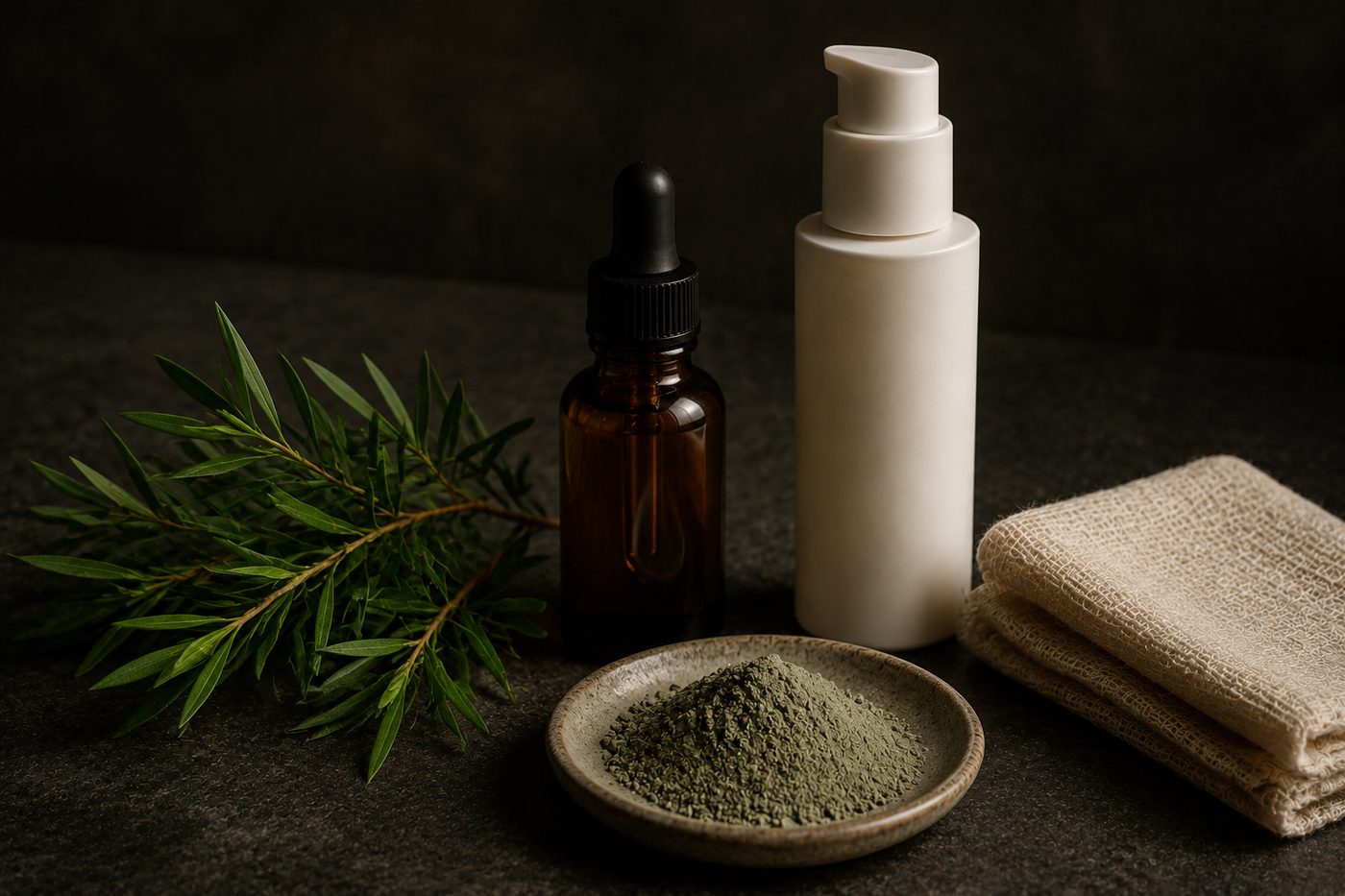
- Tea tree oil (5%) (good evidence) — the best-studied natural acne treatment. In a classic head-to-head it worked about as well as 5% benzoyl peroxide, more slowly but with less dryness and irritation, and a placebo-controlled trial confirmed a 5% gel beats placebo. Use a properly formulated 5% product — never undiluted essential oil on skin, which can cause dermatitis. A strong choice for sensitive skin that can't tolerate benzoyl peroxide. → Amazon · dispensary
- Niacinamide (good evidence) — a topical form of vitamin B3 that calms inflammation and helps regulate oil, well tolerated even on sensitive skin, and useful for post-acne redness. A quiet workhorse that layers well with almost everything. → Amazon
- Green tea (topical) (supportive) — topical green-tea polyphenols (EGCG) have reduced acne lesions in small trials, working on oil and inflammation. A pleasant, low-risk adjunct. → Amazon
- Neem (traditional & plausible — notably for hormonal acne) — a mainstay of Ayurvedic skin care with genuine antibacterial and anti-inflammatory activity, and it also appears to act on androgen and hormone pathways, which is likely why the tradition reaches for it in hormonally driven, oily-skin breakouts. Reasonable as a topical or internal adjunct in an androgenic picture. Important caveat: neem has well-documented anti-fertility activity in animal studies — it can lower sperm counts, impair fertility, and interfere with implantation — so avoid it entirely if you're trying to conceive, pregnant, or breastfeeding. → Amazon · dispensary
- Triphala (traditional & plausible) — taken internally in Ayurveda for skin as much as digestion, on the old idea that clear skin follows a clear gut. It has antioxidant and antibacterial activity, and the gut-skin link is real, but direct acne trials are limited — a supportive role, and it doubles for gut health and daily routine. → Amazon · dispensary
- Artemisinin (emerging — specifically for androgen-driven acne) — from sweet wormwood. Its relevance to acne isn't topical, it's hormonal: a 2024 study showed artemisinins lower androgen production by driving degradation of CYP11A1, a rate-limiting enzyme in steroid synthesis — with benefit in animal models and a small human PCOS pilot. Since excess androgen is the engine of androgenic acne, that's a specific, mechanism-based rationale, and a real step up from where I'd filed it before. Still early — acne-specific trials are pending — so I'd use it as a monitored, informed option under guidance, not an established treatment. → dispensary
- Zinc (oral) (supportive) — oral zinc has modest evidence for inflammatory acne and can help when there's a reason to think intake is low; less potent than antibiotics but low-risk at sensible doses. The studied range is roughly 30 mg elemental daily, taken with food to spare your stomach — and if you stay above 40 mg long-term, it depletes copper, so extended courses should include copper or a clinician's eye. → Amazon · dispensary
The conventional ladder
Over-the-counter,
step by step
This is the sequence the algorithm draws from. Climb it one rung at a time, giving each six to eight weeks, and don't add three things at once — you won't know what worked or what irritated you.
- Rung 1 — Salicylic acid cleanser, low strength (0.5–2%). A gentle exfoliating acid that unclogs pores; the sensible first active for almost everyone. → Amazon
- Rung 2 — Step up the salicylic acid, and/or add a benzoyl peroxide wash (2.5–5%). Benzoyl peroxide kills acne bacteria, and unlike with antibiotics, the bacteria don't develop resistance to it. Start 2.5%, a few times a week — it can bleach fabric and dry the skin. → Amazon
- Rung 3 — Add an over-the-counter retinoid: adapalene 0.1%. This is the quiet hero of OTC acne care — a true retinoid (once prescription-only) with strong evidence, especially for blackheads, whiteheads, and prevention. Start every other night, expect some dryness and an initial purge, and pair with the benzoyl peroxide wash. Plain retinol serums are the gentler, milder cosmetic cousin if adapalene is too strong. → adapalene · retinol
- Rung 4 — Leave-on strength & azelaic acid. A leave-on benzoyl peroxide (2.5–5%) or a short-contact higher-strength salicylic mask, and/or azelaic acid (10% OTC) — excellent for inflammation and the brown marks acne leaves behind, and gentle enough for sensitive skin and pregnancy. → BP leave-on · azelaic acid
If you've climbed this whole ladder faithfully for a few months and acne persists — or if you're starting with deep nodules, cysts, or any scarring — the next rung isn't another product. It's a prescription. More on that below.
Light therapy
The LED question
There's genuine science behind light. Blue light (around 415 nm) kills C. acnes, the bacteria in acne, and red light calms inflammation; combined blue-and-red LED has reduced lesions in studies, often by roughly half over several weeks. At-home LED masks are a reasonable adjunct for mild-to-moderate inflammatory acne — low-risk, drug-free, and a nice complement to the foundation, though not a standalone cure and slower than actives. → at-home LED mask
The in-office versions are stronger — professional light and photodynamic therapy can treat more stubborn cases. That's part of what we offer through photobiomodulation and aesthetic medicine.
Over-the-counter care handles a lot, but not everything — and knowing when you've hit that line is its own kind of medicine. See a physician if you have deep, painful nodules or cysts, any scarring, acne that hasn't budged after a faithful three-month OTC effort, or breakouts that track with your cycle (along the jaw, often with irregular periods or excess hair growth — a possible hormonal or PCOS picture worth evaluating).
Prescription tools — topical retinoids (retinoic acid/tretinoin), combination topicals, oral antibiotics used briefly and strategically, hormonal treatment like spironolactone, and isotretinoin for severe or scarring acne — are genuinely effective and worth it when indicated. Scarring acne especially shouldn't be left to trial and error; the scars are permanent. And if scarring has already happened, it isn't a life sentence — once the acne itself is controlled, laser resurfacing can treat it: the laser guide's acne-scar path → If the planner above pointed you here, that's not a failure — it's the right door.
Request an AppointmentCommon Questions
Acne — FAQs
Does diet actually affect acne?
Yes — more than dermatology used to admit. The strongest signals are high-glycemic-load diets (sugar, refined starch) and dairy, especially skim milk and whey. Low-glycemic diets improved acne in randomized trials, and large reviews link skim milk to more acne. Diet won't clear severe acne alone, but it's a real, free lever that often shows on mild-to-moderate skin.
What's the first thing to try for mild acne?
A gentle routine plus a low-strength salicylic acid cleanser, an oil-free non-comedogenic moisturizer, daily sunscreen, and diet changes. If that's not enough after a few weeks, step up salicylic acid, add a benzoyl peroxide wash, then OTC adapalene. Give each step six to eight weeks — quitting early is the most common mistake.
Is tea tree oil as good as benzoyl peroxide?
Roughly, with trade-offs. A classic trial found 5% tea tree oil about as effective as 5% benzoyl peroxide, but slower and with fewer side effects; a placebo-controlled trial confirmed 5% tea tree gel beats placebo. A legitimate, gentler option for mild-to-moderate acne — use a proper 5% preparation, never undiluted oil.
Do LED light masks work?
There's real science. Blue light kills acne bacteria and red light calms inflammation; combined LED has cut lesions by around half in studies over several weeks. At-home masks are a reasonable adjunct for mild-to-moderate inflammatory acne — not a standalone cure, but a low-risk add-on. In-office light and photodynamic therapy are stronger.
When do I need a prescription?
For deep nodules or cysts, any scarring, acne unresponsive to a good OTC routine after about three months, or cycle-linked jawline breakouts with irregular periods or excess hair growth. Prescription retinoids, combination topicals, oral antibiotics, hormonal treatment, and isotretinoin work well but need a clinician — and scarring acne shouldn't be left to trial and error.
Can I use retinoids and benzoyl peroxide together?
Yes, and together they beat either alone — but go slow. Use benzoyl peroxide in the morning and adapalene at night, starting every other night and building up. Expect some dryness and a possible early purge, wear sunscreen, and ease off if skin gets raw rather than pushing through.
The tea tree, niacinamide, neem, triphala, and zinc I use are in my online dispensary at patient pricing, and the everyday over-the-counter items are linked to Amazon where they come up. Or buy any of it anywhere — match the strengths named here and introduce one active at a time. The advice doesn't change based on where you buy it.
This guide and its interactive planner are general education, not medical advice, and do not create a physician-patient relationship or constitute a diagnosis or treatment plan for you specifically. Product suggestions are examples, not endorsements of a specific brand; introduce one active at a time, patch-test, and follow label directions. Salicylic acid, benzoyl peroxide, and retinoids increase sun sensitivity — use sunscreen. Retinoids (including adapalene and prescription retinoic acid) should not be used in pregnancy, and several acne treatments require medical supervision. Deep, painful, or scarring acne, or acne unresponsive to over-the-counter care, warrants evaluation by a physician. These statements have not been evaluated by the FDA and are not intended to diagnose, treat, cure, or prevent any disease. Disclosure: As an Amazon Associate, Starsiak Osteopathic Clinic earns from qualifying purchases through the Amazon links on this page, and Dr. Starsiak earns from purchases through the Fullscript dispensary — at no extra cost to you. The price you pay is unchanged, and the advice is the same wherever you buy.