A Guide from Dr. Starsiak · Evidence-Tiered
Lowering your cholesterol
without a prescription
Starting with an uncomfortable possibility: the number you've been told to worry about may not be the number that matters.
Do not stop a prescribed cholesterol medication because of this page. And if you already have heart disease, diabetes, a high calcium score, or familial hypercholesterolemia, understand up front that the size of the job may exceed what this toolkit does — and that delay carries a cost that doesn't announce itself.
There's a section further down called the statin came from a mold. It's the most important part of this page. Nothing here is meant to replace a physician who knows your history — it's meant to make you a better-informed participant in that conversation, and the prescription options, statins and beyond, are on the table there.
Start here
You're probably watching
the wrong number
Almost everyone with a cholesterol problem has been handed one number: LDL-C. It's the number on the report, it's the number the pharmacy ad talks about, and it's the number people white-knuckle about at two in the morning.
Here's the thing. LDL-C measures the cholesterol mass being carried inside LDL particles. But atherosclerosis isn't caused by cholesterol mass floating around. It's caused by particles — specifically, atherogenic particles physically getting into the artery wall and lodging there. It's a traffic problem, not a cargo problem.
ApoB counts the particles. Every atherogenic particle carries exactly one ApoB molecule — one particle, one tag. So measuring ApoB tells you how many trucks are on the road. LDL-C tells you roughly how much total cargo they're carrying, which is a different question and sometimes a badly misleading one.
Most of the time those two track together and it doesn't matter. But when they diverge — and they diverge exactly when things are most interesting, with high triglycerides, insulin resistance, thyroid disease, or particle discordance — LDL-C can quietly reassure you while your particle count says otherwise. Or the reverse.
Take one person, one blood draw: LDL-C of 109, ApoB of 97.
Chase an LDL-C under 70, and you're looking at roughly a 35% reduction. That's a serious undertaking — realistically a statin-sized job.
Follow ApoB toward under 90 instead, and you need about an 8% reduction. That's psyllium and plant sterols. That's a Tuesday.
Same person. Same blood. The marker you follow changed the entire size of the job.
To be clear, this isn't a trick for making a scary number look friendly — ApoB targets tighten as your risk rises, and a high-risk person may need ApoB well under 80 or 70. The point is that following the more informative marker tells you what job you're actually facing, instead of one built from a proxy.
So: ask for ApoB and non-HDL-C alongside your standard panel. Non-HDL-C is free — it's just total cholesterol minus HDL, already sitting on your existing report. ApoB is a cheap, widely available test that most people have never been offered.
From the Channel
Watch: lowering cholesterol without a prescription
Before you change anything
Get the labs that tell you
why
High cholesterol is a finding, not a diagnosis. Before anyone concludes your diet failed, it's worth asking whether something else is driving it — because a meaningful number of people are treated for years for a lipid problem that was really a thyroid problem.
- Fasting lipid panel, plus ApoB and non-HDL-C — and the TG/HDL ratio, which is a quick read on insulin resistance.
- CMP with ALT and AST — liver, kidney, and a baseline before any supplement that could stress either.
- A1c and fasting glucose — because insulin resistance drives an enormous share of real-world lipid trouble.
- TSH and free T4 — hypothyroidism raises cholesterol, and it's the classic miss. Treat the thyroid and the lipids often follow.
- hs-CRP — but only when you're genuinely well. A cold will spoil it.
- Lp(a) — once, ever. It's largely genetic and it barely moves. One measurement in your lifetime tells you whether you're carrying a risk factor nobody warned you about. Most people have never had it drawn.
Other things that quietly raise cholesterol: a very high saturated-fat or keto-style pattern, nephrotic syndrome, cholestasis, several medications, and menopause. And if the numbers are dramatic and run in your family, familial hypercholesterolemia deserves real consideration — that's a different conversation with a different urgency.
The base
The Portfolio diet —
a portfolio, not a hero
The single most effective non-prescription tool isn't a supplement. It's a specific dietary pattern with actual trial data, and its whole design principle is in the name: no one magic food — a portfolio of cholesterol-lowering foods used together, where the effects add up.
Under intensive controlled-feeding conditions the Portfolio diet has produced LDL reductions around 35%. Real-world adherence delivers less — call it 10–20% — but that's still a statin-scale effect from food, and there's no version of this where the supplements below outperform it.
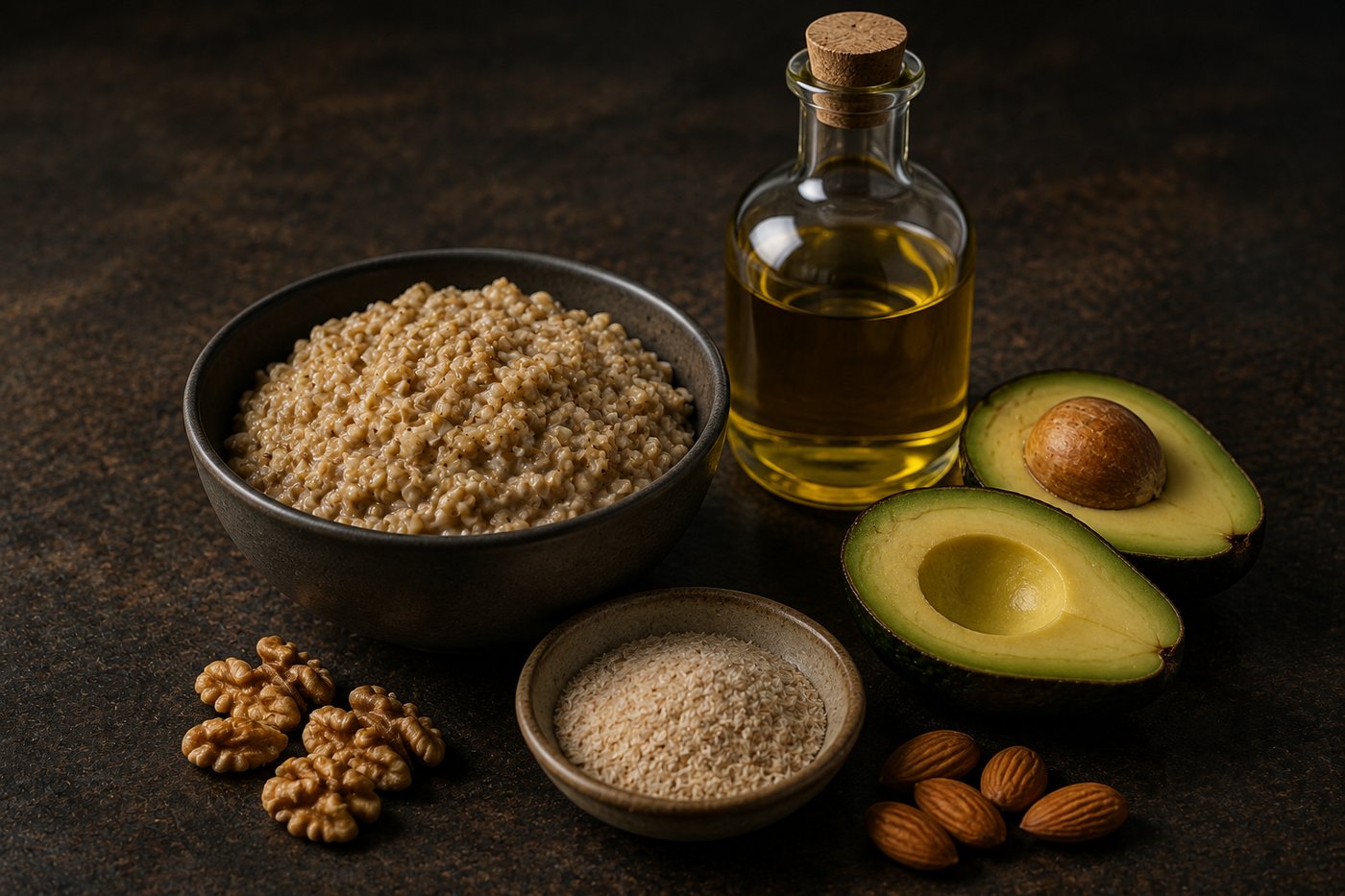
- Viscous soluble fiber, 10–20 g/day. Oats, barley, legumes, okra, eggplant, chia, flax, pectin-rich fruit. Psyllium at 5 g twice daily is the practical anchor. This binds bile acids and forces cholesterol out.
- Plant sterols/stanols, 2 g/day, taken with meals containing fat — they work by competing with cholesterol for absorption, so timing matters. Split across lunch and dinner.
- Soy or plant protein, ~25 g/day. Tofu, tempeh, edamame, soy milk, or legumes if you avoid soy. Direct effect is modest, around 3–4% — but the replacement effect is bigger, because every serving is one not spent on cheese or red meat.
- Nuts, 30–45 g/day. Almonds, walnuts, pistachios. Adjust calories elsewhere.
- Fat quality. Replace butter, cream, cheese, coconut oil, palm oil, and fatty or processed meat with olive oil, avocado, nuts, seeds, and legumes. Saturated fat under roughly 7–10% of calories if you're an LDL responder. This is often the highest-yield single change — especially for hyper-responders, ApoE4 carriers, and anyone who's gone keto or carnivore and watched their LDL climb.
What a day looks like: oats with psyllium, berries, and ground flax for breakfast. Legumes or tofu with vegetables and olive oil at lunch. A handful of nuts. Fish, soy, or legumes with vegetables and barley or beans at dinner.
Aim for 80/20 adherence rather than perfection. But note the design: each component needs to be present daily, not sporadically. The portfolio only works as a portfolio.
Supplements
What actually works
Tiered by evidence and by role. These stack on top of the diet — they don't stand in for it.
Foundation
- Psyllium husk — 5 g twice daily, with plenty of water. LDL-C down roughly 5–10%, with a modest ApoB improvement. Binds bile acids and drives cholesterol excretion; meta-analyses support both LDL and ApoB benefit. Cautions: separate it from medications and other supplements by two or more hours — it binds those too. Titrate slowly or you'll be bloated and blame me. Not for anyone with swallowing difficulty or an esophageal stricture. → Amazon
- Plant sterols / stanols — 2 g/day with fat-containing meals, split doses work better. LDL-C down roughly 8–10%, up to about 12% at 3 g/day. Blocks intestinal cholesterol absorption. Guideline-recognized. Cautions: absolutely avoid in sitosterolemia; may slightly reduce carotenoid absorption unless your diet is genuinely colorful. → Amazon
The core agent
- Berberine — 500 mg twice daily with meals, three times daily if needed and tolerated. LDL-C typically down 10–20 mg/dL, ApoB likely down, triglycerides down when insulin resistance is present.
This is the one natural compound I'd treat as a core lipid intervention rather than an adjunct. It upregulates the LDL receptor, downregulates PCSK9, and has AMPK effects that help the metabolic picture at the same time. You'll see it marketed as "nature's PCSK9 inhibitor" — worth being precise about that: PCSK9 activity in a dish is not the 50–60% LDL reduction you get from injectable PCSK9 antibodies. It's real, it's meaningful, it's not that.
Bioavailability is poor, so dihydroberberine or silymarin-enhanced forms absorb better.
The cautions here are serious and specific: berberine is a potent inhibitor of CYP3A4, CYP2D6, CYP2C9, and P-glycoprotein — which means real interaction risk with narrow-therapeutic-index drugs like cyclosporine. Possible QT prolongation. Monitor glucose if you're on diabetes medication. GI upset and constipation are common. And it is contraindicated in pregnancy, breastfeeding, and in newborns — berberine displaces bilirubin from albumin, which carries a kernicterus risk. That last one is not a theoretical footnote. → Amazon
Useful adjuncts
- Citrus bergamot — 500 mg twice daily; prefer a BPF-standardized product. LDL-C down roughly 5–15%; ApoB modestly; TG variable. A 12-week clinical study showed reductions in total cholesterol, LDL-C, and ApoB. Cautions: product variability is the main issue — standardization matters more than brand. → Amazon
- Ground flaxseed — 2 tablespoons/day. LDL modestly down; ApoB may improve. Soluble fiber plus lignans plus ALA. Ground, not whole — whole flax passes straight through and does nothing but decorate your stool. Separate from medications. → Amazon
- Artichoke leaf extract — 500–1,000 mg/day standardized. Total cholesterol and LDL modestly down; TG may fall. May reduce synthesis and improve bile flow. Cautions: avoid with bile duct obstruction or gallstones; it's in the Asteraceae family, so skip it with ragweed-type allergies. → Amazon
- Amla (Emblica officinalis) — 500 mg twice daily. A randomized double-blind placebo-controlled multicenter study showed improvements in total cholesterol, triglycerides, lipid ratios, and the ApoB/ApoA1 ratio. Promising, and quite product-specific. Cautions: caution with anticoagulants and antiplatelets, before surgery, and with hypoglycemia risk. → Amazon
- Green tea — 2–4 cups/day brewed, unsweetened. Modest LDL benefit. Prefer the beverage, not the extract: European regulators flagged a hepatotoxicity signal with concentrated green tea extract at ≥800 mg EGCG/day. Brewed tea has a substantially better safety profile and I'd rather you drank it than capped it.
The uncomfortable one
Red yeast rice is a
statin
Red yeast rice is the most potent non-prescription LDL tool there is — roughly 15–25% or more. It's on every "natural cholesterol" list. And you'll notice it isn't in the list above, or on my Amazon storefront, and I want to tell you exactly why.
Red yeast rice works because it contains monacolin K. Monacolin K is chemically identical to lovastatin. Not similar to. Identical. It is a prescription statin that happens to be produced by a mold rather than a factory.
Which means it carries statin risks, because it is one: muscle pain and muscle injury, liver injury, and the same drug interactions. It must never be combined with a prescription statin — that's additive statin toxicity, and people do it precisely because they've been told one of the two is a gentle herb.
Now the part that makes it worse than a statin rather than better. Monacolin content varies wildly and unpredictably between products. Two bottles on the same shelf can differ by an order of magnitude. So you are taking a statin at a dose nobody has told you, without a baseline, without monitoring, and without anyone watching your liver. And red yeast rice can be contaminated with citrinin — a nephrotoxic mycotoxin — so any product worth taking must be citrinin-tested, which most aren't.
A statin you buy without knowing the dose and without monitoring isn't a safer statin. It's a less supervised one.
I'm not against red yeast rice. In the right person, with a third-party-tested and citrinin-tested product, with informed consent and the same monitoring I'd do for lovastatin, it's a legitimate option — and my own protocol says exactly that. But it belongs in an appointment, not a cart, and I'm not going to hand you an affiliate link to an unsupervised statin. If it's right for you, come talk to me and we'll do it properly. It also depletes CoQ10, and it's out entirely in pregnancy, breastfeeding, liver disease, or heavy alcohol use.
The honest part
What doesn't work
This section will cost me money and it's the reason you should trust the rest of the page.
- Guggul / guggulipid — actively avoid. A placebo-controlled randomized trial published in JAMA found guggulipid didn't improve cholesterol, and LDL-C actually rose relative to placebo. It went the wrong way. It also causes rash and GI effects and has CYP interactions. It's still sold everywhere as a cholesterol herb. It shouldn't be.
- Garlic — wrong target. A rigorous Stanford trial found neither raw garlic nor common garlic supplements meaningfully lowered LDL. Worth being precise about what that does and doesn't say: garlic wasn't shown to be inert — it was shown not to move this number. It has better data for blood pressure and vascular health. Right herb, wrong problem.
- Flush-free niacin / niacinamide — not the same drug. Niacinamide does not produce nicotinic acid's lipid effects. "Flush-free" removes the flush by removing the mechanism. If someone sells you flush-free niacin as triglyceride or Lp(a) therapy, they either don't know or don't care.
- Fish oil for LDL — wrong target, and possibly backwards. Omega-3 is a triglyceride tool. DHA-containing products can raise LDL-C in some people. Use it for triglycerides, omega-3 index, or inflammation. Not for LDL.
- CoQ10 — supportive, not lipid-lowering. Reasonable to consider for statin-associated muscle symptoms, though even there the evidence is mixed. It does not meaningfully lower LDL or ApoB. It's a tolerability tool.
- Policosanol — low confidence. Early Cuban data looked great. Independent replication has been inconsistent ever since, which is usually the tell.
- "Cholesterol cleanse" blends — avoid. These typically combine underdosed fiber, garlic, phytosterols, and niacin with no meaningful standardization. You're paying for a gesture. Use single agents at doses that were actually studied.
Guggul is the one I'd underline. It's not that it failed to help — it's that in a controlled trial, cholesterol got worse. That's what the evidence base is for. Traditional use tells you a lot about safety over centuries; it can't tell you a compound is quietly moving your LDL the wrong way. Only a trial catches that, and only if someone runs it.
A different pattern
If triglycerides are
your problem
High triglycerides with insulin resistance is a different animal from high LDL with normal triglycerides, and it needs different tools. Chasing LDL here misses the point.
The levers that matter: reduce refined carbohydrate and alcohol — alcohol especially, it's often the whole story — lose weight if that applies, and exercise. Berberine shines here because it works on the insulin side as well as the lipid side. Fiber helps. Bergamot helps.
On omega-3, the details matter more than usual. High-dose EPA/DHA lowers triglycerides roughly 20–30%. But EPA-predominant preparations are clinically different from mixed EPA/DHA: the EPA-only outcome trial reduced cardiovascular events, while the mixed EPA/DHA outcome trial was neutral. And DHA-heavy products can raise LDL. So if triglycerides are high and LDL is also a concern, EPA-predominant is the smarter choice. My apothecary runs vegetarian, so algae-derived is the route here rather than fish oil — algae EPA-forward options exist. → Amazon
And a hard line: triglycerides at or above 500 is a pancreatitis risk, not a supplement project. That's a same-week physician conversation. Eliminate alcohol and simple sugar, get evaluated for diabetes and thyroid disease, review your medications, and get proper oversight. Please don't manage that number off a website.
Where a physician actually earns their keep
The statin came from
a mold
Lovastatin — the first statin — was isolated from a fungus. Red yeast rice, further up this page, is that same fungus. The pharmaceutical industry didn't invent statins so much as find them, purify them, and standardize the dose.
That's the rule, not the exception. Metformin traces to French lilac. Aspirin to willow bark. Digoxin to foxglove. Morphine to poppy. The line between "natural" and "pharmaceutical" is mostly a line between unmeasured and measured — not between folk belief and real medicine. Plants have been the pharmacy the whole time.
So I want to be careful about what the evidence gap actually means. Statins, ezetimibe, bempedoic acid, PCSK9 antibodies and inclisiran have something nothing else on this page has: cardiovascular outcome trials — real data on whether people had fewer heart attacks and lived longer, not just whether a number on a lab report moved.
That's a genuine difference and I won't soften it. But it's worth being precise about why it exists. Those trials cost hundreds of millions of dollars, and that money follows patents. Nobody is going to fund a thirty-thousand-person outcome trial on psyllium, because there's no way to earn the money back. The absence of a trial is usually a fact about our funding model, not a verdict on the molecule. Bergamot hasn't failed an outcome trial. It's never been given one.
What that leaves you with is a question about certainty, not about worth. With a statin, we know what happens to hard endpoints. With berberine, we know the lipids move and we're extrapolating the rest. When your risk is modest, that extrapolation is a perfectly reasonable bet — and it comes with benefits a statin doesn't have. When your risk is high, you may want the option where the certainty has already been bought and paid for.
Which is exactly the judgment a physician is for.
- Reaching your goal needs more than roughly a 35% LDL reduction
- You have established cardiovascular disease
- You have diabetes
- Your coronary calcium score is high
- You have a familial hypercholesterolemia phenotype
- Your ApoB stays elevated despite genuine, sustained adherence
None of those mean the herbs stop. They mean the stakes have risen to where the choice of tool matters more than the philosophy behind it — and where someone should be looking at your labs, your family history, your calcium score, and your medication list rather than a general article on the internet.
And this was never either/or. The Portfolio diet, the fiber, and the sterols keep working alongside a prescription, often allow a lower dose, and are doing a dozen other things for your body that no statin does. Filling a prescription doesn't make the food stop mattering. Adding a statin to a good diet is a strictly better position than either alone.
The thing this page cannot replace is a relationship. An article can tell you what berberine does. It can't examine you, it can't read your labs, it can't weigh your particular risk against your particular values, and it can't notice the thing you didn't think to mention. Selection, dose, monitoring, and knowing when to change course — that's the part that requires a physician who knows you, and it's the part I'd never want you to get from a website. Including mine.
Sequencing & monitoring
How to run this
Baseline. The labs above, before you start. Find the secondary causes first.
Mild elevation, low triglycerides: Portfolio diet + psyllium 5 g twice daily + plant sterols 2 g/day. Expect roughly 10–20% if you're adherent. Good first step.
Need 25–35%: add berberine 500 mg two or three times daily and bergamot 500 mg twice daily. A reasonable intensive non-statin-like stack.
Need more than 35%: this is where red yeast rice or a prescription enters the conversation — with a physician, with monitoring, with informed consent.
Recheck at 8–12 weeks. Fasting lipids, ApoB, non-HDL-C, triglycerides. Add a CMP if you're on red yeast rice, niacin, concentrated green tea extract, or a multi-agent stack. Most of what works here is visible by twelve weeks — and if nothing moved, that's information, not failure.
Muscle symptoms? Stop any statin-like product and get a CK and CMP. Liver enzymes up? Stop the liver-risk items first — red yeast rice, niacin, green tea extract, high-dose curcumin — and look at alcohol and acetaminophen while you're there.
Pregnancy, breastfeeding, or trying to conceive: red yeast rice, berberine, and high-dose green tea extract all stop. The pregnancy-compatible base is diet plus psyllium plus plant sterols, coordinated with your obstetric care.
Common Questions
Cholesterol — FAQs
Is ApoB really better than LDL-C?
As a follow-up marker, usually yes. LDL-C measures cholesterol mass; ApoB counts atherogenic particles, and each carries exactly one ApoB. Atherosclerosis is a particle problem. When the two disagree — high triglycerides, insulin resistance, thyroid disease — ApoB is the more reliable guide. Ask for it. It's cheap and most people have never been offered it.
What actually works without a prescription?
The Portfolio diet is the base — 10–20% real-world, more under intensive conditions. Then psyllium (5–10%), plant sterols (8–10%), berberine, and citrus bergamot. A full adherent stack can reach 20–35%.
Does garlic lower cholesterol?
No, not reliably — a rigorous Stanford trial found no meaningful LDL effect from raw garlic or common supplements. It does have real blood pressure evidence, so it's not useless. It's aimed at the wrong target.
Why isn't red yeast rice on your list?
Because it's a statin. Monacolin K is chemically identical to lovastatin. It's the most potent option precisely because of that — and it carries statin risks, can't be combined with a prescription statin, varies unpredictably in dose between products, and can be contaminated with citrinin. It's a legitimate option with the right product and real monitoring. It's not something I'll hand you an affiliate link for.
Does fish oil lower LDL?
No — wrong target. Omega-3 is a triglyceride tool, and DHA-containing products can raise LDL in some people. If triglycerides are the issue, EPA-predominant is preferred: the EPA-only outcome trial was positive, the mixed EPA/DHA one was neutral.
When is a prescription the better choice?
When the job is bigger than this toolkit, or your risk is high enough that certainty matters more than mechanism — needing more than ~35% reduction, established heart disease, diabetes, high calcium score, familial hypercholesterolemia, or ApoB that stays up despite real adherence. Statins have outcome trials; the botanicals don't — largely because those trials cost hundreds of millions and that money follows patents. They weren't beaten, they were never entered. Either way it's a decision worth making with a physician who knows your numbers, and the diet keeps working alongside whatever you choose.
How long until I see a change?
8–12 weeks for most of this. Recheck fasting lipids plus ApoB then. If nothing moved, that's data — it usually means adherence, absorption, an untreated secondary cause, or that the job is genuinely bigger than this toolkit.
If you've never had ApoB or Lp(a) drawn, if your LDL won't move despite doing everything right, or if you want to know honestly whether a supplement stack is enough for your risk rather than in general — that's the conversation. Sometimes I'll tell you the shelf is enough. Sometimes I'll tell you it isn't, and that's worth hearing too.
The berberine, bergamot, psyllium, and algae omega I use in my protocols are in my online dispensary at patient pricing, with dosing attached. Or buy any of it anywhere — check third-party testing and check the dose against the studied dose, and you have what you need. The advice doesn't change.
This guide is general education, not medical advice, and it does not create a physician-patient relationship. It is not a treatment plan for you specifically. Do not start, stop, or change any prescribed medication based on this page. Supplements are not FDA-approved to treat hyperlipidemia. Lipid figures are approximate averages from published human research; individual results vary and product potency and quality vary substantially. Several agents described here have significant drug interactions — review anything new with your physician or pharmacist first, and do not delay indicated therapy in high-risk disease. These statements have not been evaluated by the FDA and are not intended to diagnose, treat, cure, or prevent any disease. Disclosure: As an Amazon Associate, Starsiak Osteopathic Clinic earns from qualifying purchases through the Amazon links on this page, and Dr. Starsiak earns from purchases through the Fullscript dispensary — at no extra cost to you. The price you pay is unchanged, and the advice is the same wherever you buy.